


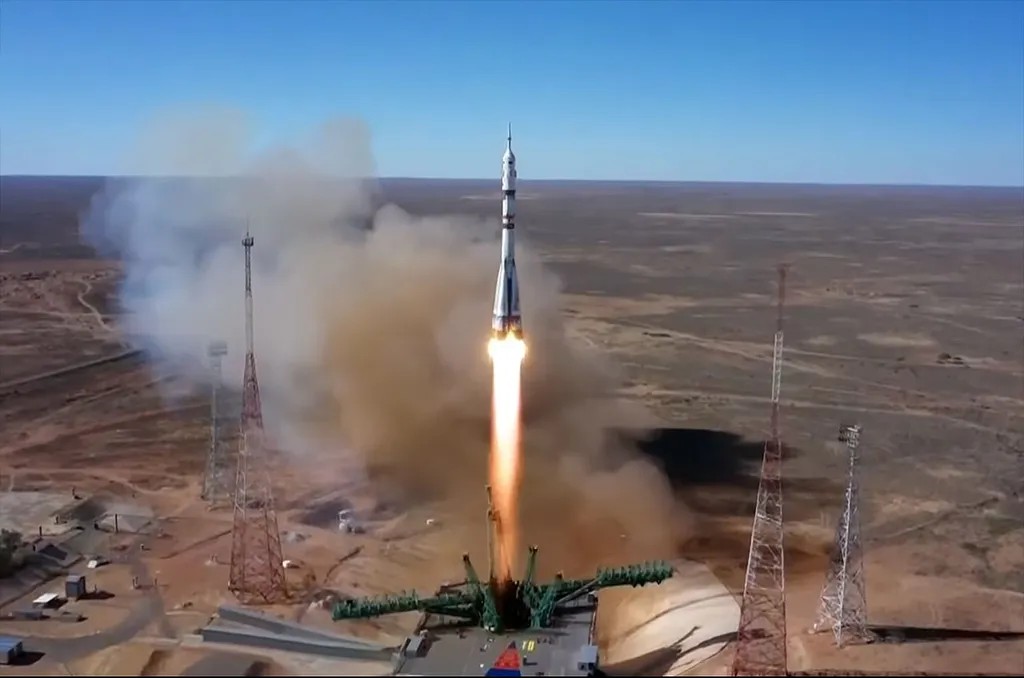
Kazakhstan’s Baikonur Cosmodrome once again played a central role in global human spaceflight recently, as crews arrived and departed the International Space Station (ISS) through launches and landings on Kazakh soil. The events highlighted Baikonur’s continued importance as one of the world’s most active and historically significant spaceports, more than 70 years after it first enabled humanity’s earliest steps into space.
On 27 November, a Soyuz MS-28 spacecraft lifted off flawlessly from Baikonur’s Site 31 launch pad, carrying NASA astronaut Christopher Williams and Roscosmos cosmonauts Sergey Kud-Sverchkov and Sergey Mikaev. Williams, embarking on his first spaceflight, is joining Expedition 74 aboard the ISS. The launch maintained the long-standing practice of mixed US–Russian crews travelling on each other’s spacecraft to sustain continuous operations on the station.
Just days later, on 9 December, another joint crew returned to Earth in Kazakhstan following an eight-month mission. NASA astronaut Jonny Kim and Roscosmos cosmonauts Sergey Ryzhikov and Alexey Zubritsky landed safely in the steppe southeast of Zhezkazgan after 245 days in orbit, during which they circled Earth nearly 4,000 times and conducted a range of scientific experiments. Search-and-rescue teams deployed in the landing zone recovered the crew shortly after touchdown.
These two missions are part of a pattern that has endured for decades: Baikonur is one of the few places on Earth from which humans regularly launch into space and where they routinely return. Since the 1950s, the cosmodrome has supported thousands of space missions and has been the departure point for astronauts and cosmonauts from many countries, including the United States, Russia, Europe, Japan, and others. Even as new commercial launch providers and additional crewed vehicles have emerged, Baikonur remains an essential component of global space infrastructure.
The year 2025 marked the 70th anniversary of Baikonur’s establishment, a milestone that prompted renewed discussion about its past and future. Built at the dawn of the space age, the cosmodrome hosted many of the defining chapters of human space exploration, from the launch of the first satellite and the first human in orbit to a long list of international missions that followed. Today, it continues to support frequent crewed and uncrewed launches to the ISS, reflecting a level of continuity unique in the global space sector.
The safe landing of the MS-27 crew demonstrates once again the reliability of the infrastructure and the cooperation that sustains it. As the host country, Kazakhstan provides the territory, logistical support, and conditions that make these operations possible, while Baikonur continues to function under long-standing bilateral arrangements. The cosmodrome’s role extends beyond operations: it is an anchor of international scientific collaboration and one of the world’s most recognisable symbols of human exploration.
As discussions on the future of human spaceflight evolve, including NASA’s Artemis programme, renewed lunar ambitions, and new commercial actors, Baikonur remains one of the few sites with a proven track record of continuous crewed missions. The recent launch and landing serve as reminders that despite changes in technology and geopolitics, Kazakhstan continues to host one of the global centres of space activity.
With further missions already scheduled, Baikonur enters its eighth decade as a still-active platform that links generations of spaceflight. The events of this month highlight its enduring place in international space cooperation and the crucial role Kazakhstan plays in enabling it.
Press Office of the Ministry of Foreign Affairs of Kazakhstan
https://www.gov.kz/memleket/entities/mfa?lang=en
Astana, Kazakhstan