



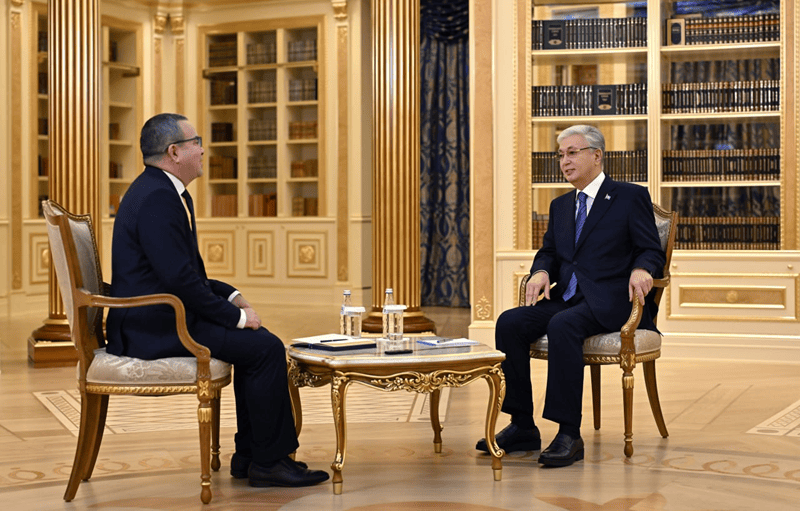
In a January 5 interview with the Turkistan newspaper, Kassym-Jomart Tokayev outlined the key outcomes of 2025 and set priorities for the year ahead, stressing that Kazakhstan has entered a new stage of modernisation marked by irreversible reforms, economic resilience, and an accelerated push toward digital transformation.
According to Tokayev, Kazakhstan’s economy grew by more than 6% in 2025, with gross domestic product surpassing $300 billion and per capita GDP exceeding $15,000. While acknowledging these achievements, President Tokayev cautioned against complacency.
“There are grounds for satisfaction, but I constantly urge all civil servants not to relax. We must work hard and move forward, especially since many unresolved issues remain,” he said.
Among the key challenges, Tokayev cited inflation, which continues to erode gains in household incomes, noting that the government and regional authorities face substantial work to strengthen the country’s socio-economic framework.
“Kazakhstan has taken a major step forward along the path of modernisation and has become a more civilized state. Society has developed a stronger understanding of the exceptional importance of large-scale transformations for the well-being of future generations,” he said.
Tax reform as a structural reset
Addressing public concerns over the new Tax Code, Tokayev emphasized that the reform represents a systemic reset rather than a short-term fiscal measure. He noted that similar reforms are underway globally and recalled that earlier proposals had suggested raising the value-added tax to 20%, a threshold he personally ordered reduced.
“The new Tax Code is intended to shift the emphasis from control to partnership, where all participants in the process – the state, business, and citizens – fulfil their obligations in good faith. In such a complementary system, taxes cease to be perceived as a burden,” Tokayev said.
According to him, it is an instrument for fair redistribution, supporting those who are weaker and strengthening those at the centre of the economy. Tokayev also underlined the importance of public trust and tax culture in ensuring the effectiveness of fiscal policy.
“Conscientious taxpayers strongly dislike it when their money ends up in the pockets of fraudsters,” Tokayev said.
He underlined that the effectiveness of fiscal policy worldwide depends not only on the quality of administration but also on the level of tax literacy and civic responsibility. Transforming it from an obligation into a modern form of patriotism, he said, structures a direct path to rejecting corruption.
Digitalization and artificial intelligence as a survival imperative
Tokayev framed digital transformation and artificial intelligence as matters of national survival in a rapidly changing technological era marked by global competition.
He pointed to Kazakhstan’s growing digital ecosystem, highlighting the role of Astana Hub, which now unites 2,000 companies, and the country’s IT exports, which reached approximately $1 billion in 2025. He also referenced initiatives such as CryptoCity, the development of Alatau City, and the expansion of state data collection.
President Tokayev also noted that institutional foundations have already been laid, including the creation of the Ministry of Artificial Intelligence and Digital Development, the adoption of the Law on Artificial Intelligence, and the launch of two national supercomputers, Alem.Cloud and Al-Farabium.
“With the emergence of artificial intelligence, a kind of watershed has formed between countries that manage to enter the future and those that remain in the past. That is why I declared digital technologies and artificial intelligence a priority for Kazakhstan’s development. This year will be decisive as I believe in the success of this critically important undertaking,” Tokayev said.
Nuclear energy and rare earths
Tokayev also underscored the strategic importance of nuclear energy, stressing that the transition to a new technological model is impossible without reliable power generation.
“The construction of several nuclear power plants is, on the one hand, a correction of a historical absurdity – being a world leader in uranium production without building a single nuclear power plant. On the other, a matter of Kazakhstan’s prestige. It should also be remembered that by building nuclear power plants, we will prepare a new class of technical professionals, which in turn will change the very essence of our state policy,” Tokayev said.
He also highlighted growing global demand for rare earth metals, which he described as a new window of opportunity for Kazakhstan, noting expanding cooperation with the United States, China, Russia, Japan, South Korea, and the European Union.
Asset recovery and anti-corruption policy
Reflecting on the January 2022 events, Tokayev said the overall picture has long been restored, with investigations conducted in close cooperation with civil society and human rights advocates. Some court proceedings and the recovery of stolen weapons remain ongoing.
He rejected claims that asset recovery efforts have been curtailed, citing the recovery of more than 1.3 trillion tenge (approximately US$2.7 billion) from oligopolistic structures, with over 1 trillion tenge (US$2.1 billion) transferred to the state budget and used to finance hundreds of social and infrastructure projects nationwide.
“Restoring social justice through the recovery of illegally acquired assets is not a matter of political expediency or a public relations campaign, but a principled position of the state. There is no question, nor can there be any question, of indulgences or behind-the-scenes arrangements,” President Tokayev said.
Tokayev emphasized that the fight against corruption remains a core priority, with reforms targeting the organisers of systemic bribery and strengthening prevention and public education.
The Turkistan newspaper has been in circulation for more than three decades and is one of Kazakhstan’s most influential print publications. In addition to covering current developments in the country, its journalists maintain a strong focus on Turkic-related themes.